

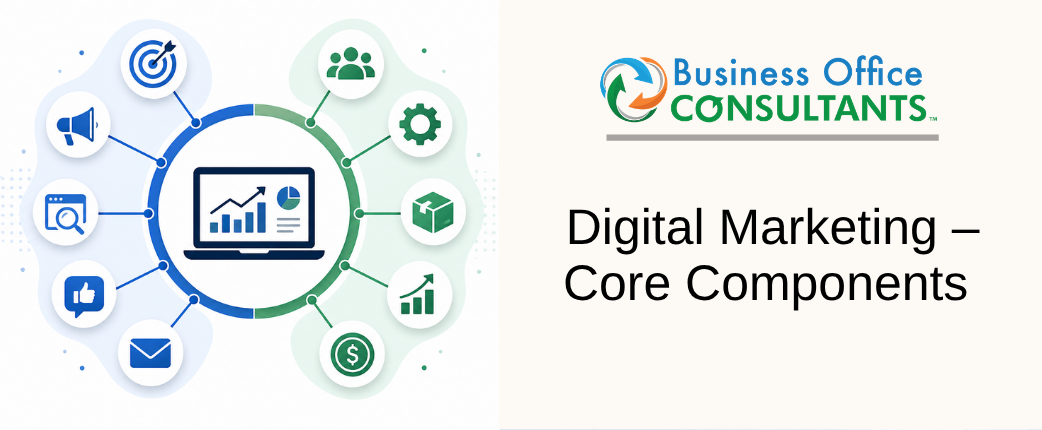
In today’s digitally driven economy, marketing is no longer confined to a single channel or tactic – it is an interconnected system designed to attract, engage, and convert audiences across multiple platforms. Digital marketing has become essential for businesses of all sizes, enabling them to reach the right people at the right time with measurable, data-driven strategies. Understanding its core components is the foundation for building campaigns that are not only visible, but effective.
This blog explores the key components that make up a successful digital marketing strategy, from search engine optimization and content marketing to social media, paid advertising, and analytics. By breaking down how each element works individually – and how they function together – you’ll gain a clearer picture of how digital marketing drives brand awareness, customer engagement, and sustainable growth in an increasingly competitive online landscape.
1. Search Engine Optimization (SEO)
SEO is a foundational digital strategy that improves your website’s visibility in search engines, driving higher-quality traffic and increasing lead-generation potential. While it requires knowledge, consistency, and optimization over time, SEO is a cost-effective growth lever that does not depend on expensive software or specialized equipment.
2. Content Marketing
Content is the foundation of digital marketing. Blogs, videos, infographics, eBooks, and social media posts educate your audience, address real-world challenges, and position your brand as a trusted authority. Because these assets are digital, distribution costs are minimal compared to physical materials, and effective content creation does not require expensive equipment—only strategy, creativity, and consistency.
3. Social Media Marketing
Digital marketing allows businesses to have a global reach without having to design and distribute a global campaign, as platforms like Facebook, Instagram, LinkedIn, and TikTok have done the work for them. Forums to allow businesses to reach audiences on a scale have already been created. Using organic posts and paid ads on those platforms, which cost significantly less than physical marketing materials, brands can build communities and drive traffic.
4. Email Marketing
Despite being one of the oldest digital channels, email remains one of the highest-ROI marketing tools available. It is highly effective for nurturing leads, promoting products or services, and delivering personalized experiences at scale. While email marketing can be more time-intensive—requiring thoughtful list building through opt-ins and engagement—it consistently outperforms many newer channels. Purchased email lists are available, but they often underperform due to poor targeting, lack of consent, and higher likelihood of being ignored or flagged as spam, making organic list growth the more sustainable strategy.
5. Pay-Per-Click Advertising (PPC)
When conducting an Internet search, almost everyone has seen a few websites with the word SPONSORED listed above it at the top of the results page; this is what is known as a PPC (Pay-Per-Click) ad. Search engines, such as Google, via their Google Ads division, allow businesses to appear at the top of search results instantly. You only pay when someone clicks, making it highly efficient and performance driven.
6. Analytics and Data Tracking
Digital marketing is powered by data. Tools like Google Analytics, as well as surveys and comments that are done online, provide instant results, help you understand audience behavior, track conversions, and continually improve your marketing efforts.
Conclusion
Digital marketing isn’t just a trend – it’s the new standard for how brands communicate and compete. By understanding its key components and using them cohesively, businesses can strengthen their presence, connect authentically with customers, and achieve sustainable growth in an ever-evolving digital landscape.